Gravure vs Flexo: Which Printing Fits Your Packaging?
Gravure or Flexo for Flexible Packaging?
Your artwork looks perfect on screen. Then production starts, and suddenly the real questions appear:
Will the colors stay consistent? Is the MOQ too high? Why is there a plate fee? Why does one supplier recommend gravure while another pushes flexo?
For buyers sourcing Flexible Packaging, the printing method is not just a technical detail. It affects cost, lead time, shelf appearance, reorder stability, and how easily your packaging can scale.
The two most common options for custom printed packaging are gravure printing and flexographic printing, often called flexo. Both can produce professional packaging. But they are not built for the same kind of project.
Here is the practical buyer’s guide.
What Is Gravure Printing?
Gravure printing is an intaglio process. In simple terms, the design is engraved into tiny recessed cells on a printing cylinder. Ink sits inside those cells, excess ink is wiped away, and the image transfers onto film or another substrate. Britannica describes gravure as a process where the image sits in depressions or recesses on the printing surface.
For flexible packaging, gravure is often used for:
Tissue packaging
Hygiene packaging
Pet product packaging
Food and beverage packaging
High-volume retail packaging
Designs requiring rich color and sharp detail
Best fit: stable artwork, larger production runs, premium shelf appearance, and repeat orders.
What Is Flexographic Printing?
Flexographic printing uses flexible rubber or elastomeric plates to transfer ink onto the packaging material. Britannica defines flexography as a rotary printing method using flexible plates, with fast-drying inks that are suitable for packaging applications.
Flexo is widely used for labels, films, paper, corrugated materials, and many types of Custom Flexible Packaging.
Best fit: shorter or medium runs, frequent design changes, faster changeovers, and projects where flexibility matters more than maximum image depth.
Gravure vs Flexographic Printing: The Real Difference
1. Print Quality
Gravure is known for strong color density, smooth gradients, fine detail, and premium visual consistency. The Gravure Association of the Americas notes that gravure is used for high-quality print applications requiring sharp, fine images, especially in package printing.
Flexo has improved a lot. Modern flexo can look very clean, especially with good prepress, plate-making, anilox control, and color management. But if your packaging has photo-realistic images, delicate shadows, metallic effects, or very demanding brand colors, gravure often gives a more luxurious result.
Buyer takeaway:
Choose gravure when the packaging needs to look “big brand.” Choose flexo when the design is simpler or when speed and flexibility are more important.
2. Cost Structure
This is where many buyers get confused.
Gravure usually has higher upfront costs because each color requires an engraved cylinder. The setup is more expensive, but once the cylinders are made, gravure becomes efficient for larger and repeated runs.
Flexo usually has lower setup costs because it uses printing plates instead of engraved cylinders. That makes it attractive for small brands, trial orders, seasonal packaging, or multiple SKUs.
Think of it this way:
Gravure is like building a production mold. Flexo is like setting up a more flexible toolkit.
For custom packaging solutions, the cheaper option depends on quantity, not just the printing method.
3. MOQ and Production Volume
If you are ordering a small batch for market testing, flexo may be easier to justify. If you are producing packaging for a high-volume tissue, hygiene, or FMCG product, gravure often becomes more cost-effective over time.
Gravure is especially strong when:
The order quantity is high
The artwork will not change often
The product has repeat demand
Brand color consistency matters
The same packaging runs every month or quarter
Flexo is stronger when:
You have several SKUs
Designs change frequently
You are testing a new market
You need shorter lead times
Your packaging design is relatively simple
4. Lead Time
Gravure takes longer at the beginning because cylinders must be produced before printing. If the artwork changes after cylinder engraving, that can mean extra time and cost.
Flexo is usually faster to prepare, especially for designs with fewer colors or projects requiring frequent updates.
For small businesses, this matters. A packaging delay can mean a product launch delay. For procurement managers, the bigger concern is supply stability. Gravure may take longer upfront, but it can be very stable once the cylinders and specifications are approved.
5. Color Consistency
For repeat orders, gravure is excellent at maintaining consistent results across large runs. That is one reason it remains popular for FMCG and retail packaging where the same product may appear across many stores.
Flexo can also achieve strong consistency, but it relies heavily on process control: plate quality, ink viscosity, anilox condition, press settings, and operator experience. The Flexographic Technical Association emphasizes consistency, predictability, and efficiency as key priorities in modern flexographic packaging production.
Expert Insight:
Do not judge a supplier only by whether they offer gravure or flexo. Ask how they control color. A professional supplier should be able to discuss proofing, Pantone matching, ink control, registration, inspection systems, and approved samples.
Which Printing Method Should You Choose?
Choose Gravure Printing If:
You need premium shelf impact
Your order volume is medium to high
Your artwork has photos, gradients, or rich colors
You expect repeat orders
Your packaging must look consistent across batches
You are supplying retail, tissue, hygiene, or FMCG markets
Gravure is often the better choice when packaging is part of the brand experience, not just a protective bag.
Choose Flexographic Printing If:
You need lower initial setup cost
Your design may change often
You have many SKUs
You are testing a new product
Your artwork is simple or graphic-based
You need faster prepress turnaround
Flexo is often a smart choice for growing brands that need professional packaging without locking themselves into high setup costs too early.
JECPACK Pro Tip: Ask These Questions Before Requesting a Quote
Before asking for a price, prepare the right information. It will save time and prevent inaccurate quotations.
Ask your supplier:
What material structure do you recommend for my product?
Is gravure or flexo better for my expected order quantity?
What is the printing plate or cylinder cost?
How many colors does my design require?
Can you match Pantone or brand color standards?
What is the MOQ for each printing method?
Can the same cylinder or plate be reused for repeat orders?
What inspection process do you use during printing?
For custom printed packaging, the right answer usually depends on your product, artwork, order volume, and sales plan.
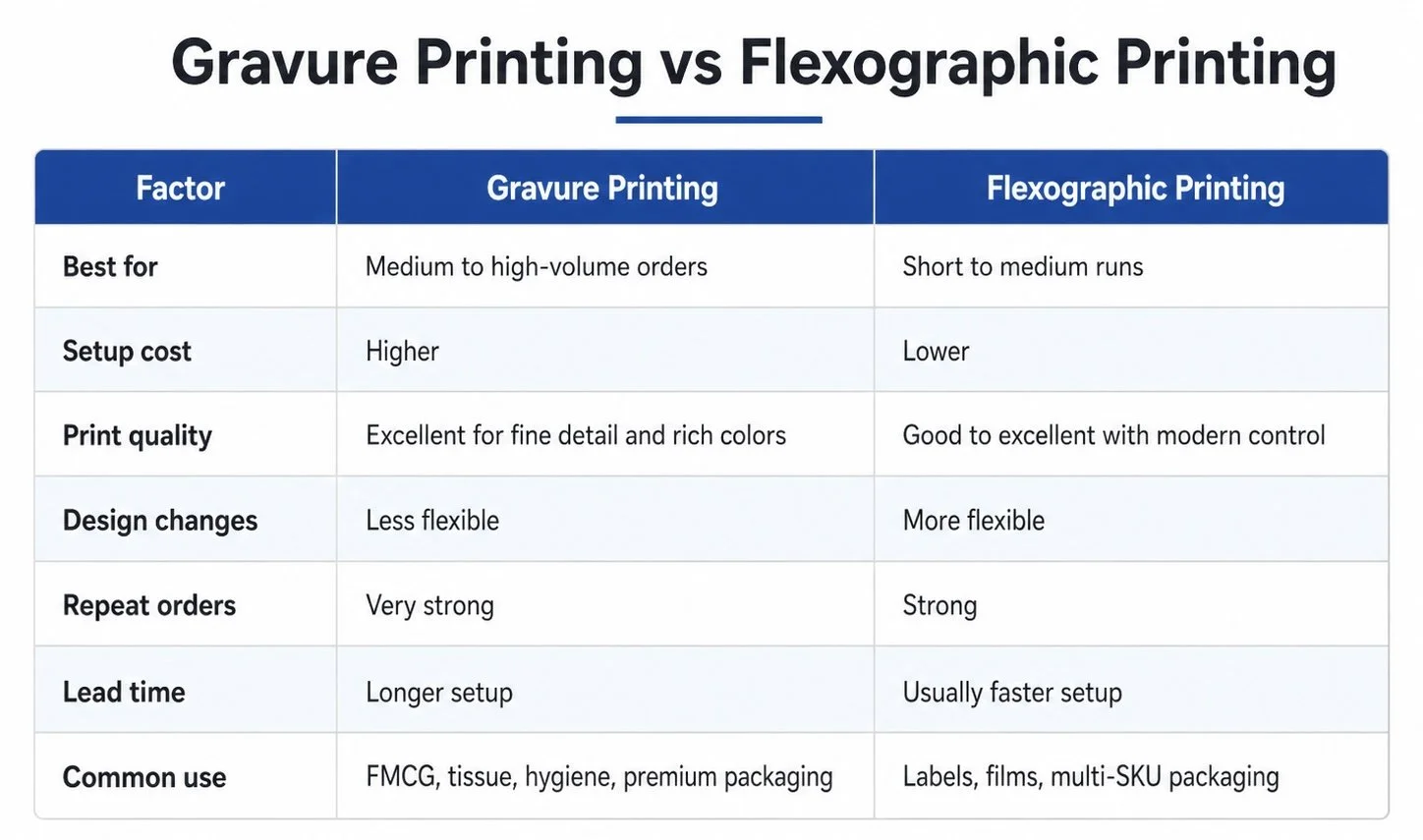
Quick Comparison Table
Final Recommendation
For small businesses, flexo can be the safer first step if you are still testing your market. For procurement managers sourcing at scale, gravure often gives better long-term consistency, stronger shelf appeal, and stable repeat production.
The smartest choice is not “gravure is better” or “flexo is cheaper.” The smartest choice is matching the printing method to your packaging strategy.
If your product needs high-volume, polished, retail-ready Flexible Packaging, gravure is worth serious consideration. If your brand needs flexibility, lower setup costs, and frequent artwork changes, flexo may be the more practical route.
Good packaging is not just printed. It is planned.
Planning a Custom Flexible Packaging Project?
Gravure or flexo is only one decision. The right packaging also depends on your product, material structure, artwork, MOQ, and target market.
Jecpack provides custom flexible packaging solutions for tissue, hygiene, pet care, industrial, and FMCG products, with integrated production from film and printing to lamination and bag-making.
Have a project in mind? Jecpack supports your packaging needs with practical manufacturing experience and clear communication. Contact us to discuss the right solution for your product. Whether you are developing new packaging, improving an existing format, or comparing supplier options, our team is ready to help you move forward with confidence.