
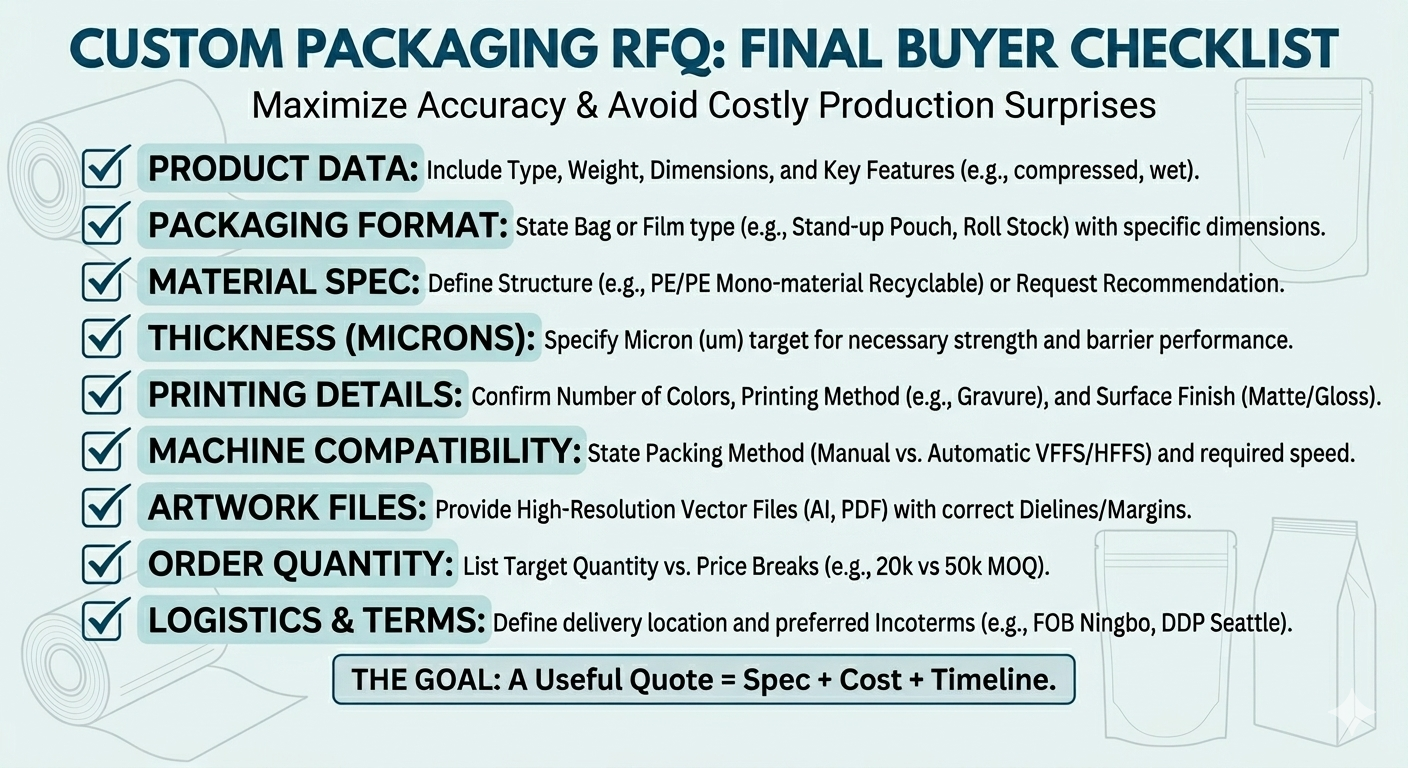
A bad packaging quote usually starts before the supplier even replies. It starts with a message like: “Hi, can you quote this bag?”
No size. No material. No thickness. No idea whether the bag needs to survive a retail shelf or a high-speed packing line. The result? The supplier guesses, the buyer compares non-comparable prices, and someone ends up with a sample that fails.
This guide explains how to structure your Flexible Packaging RFQ to get accurate pricing, faster lead times, and zero production surprises.
Why Your RFQ Details Drive Your Bottom Line
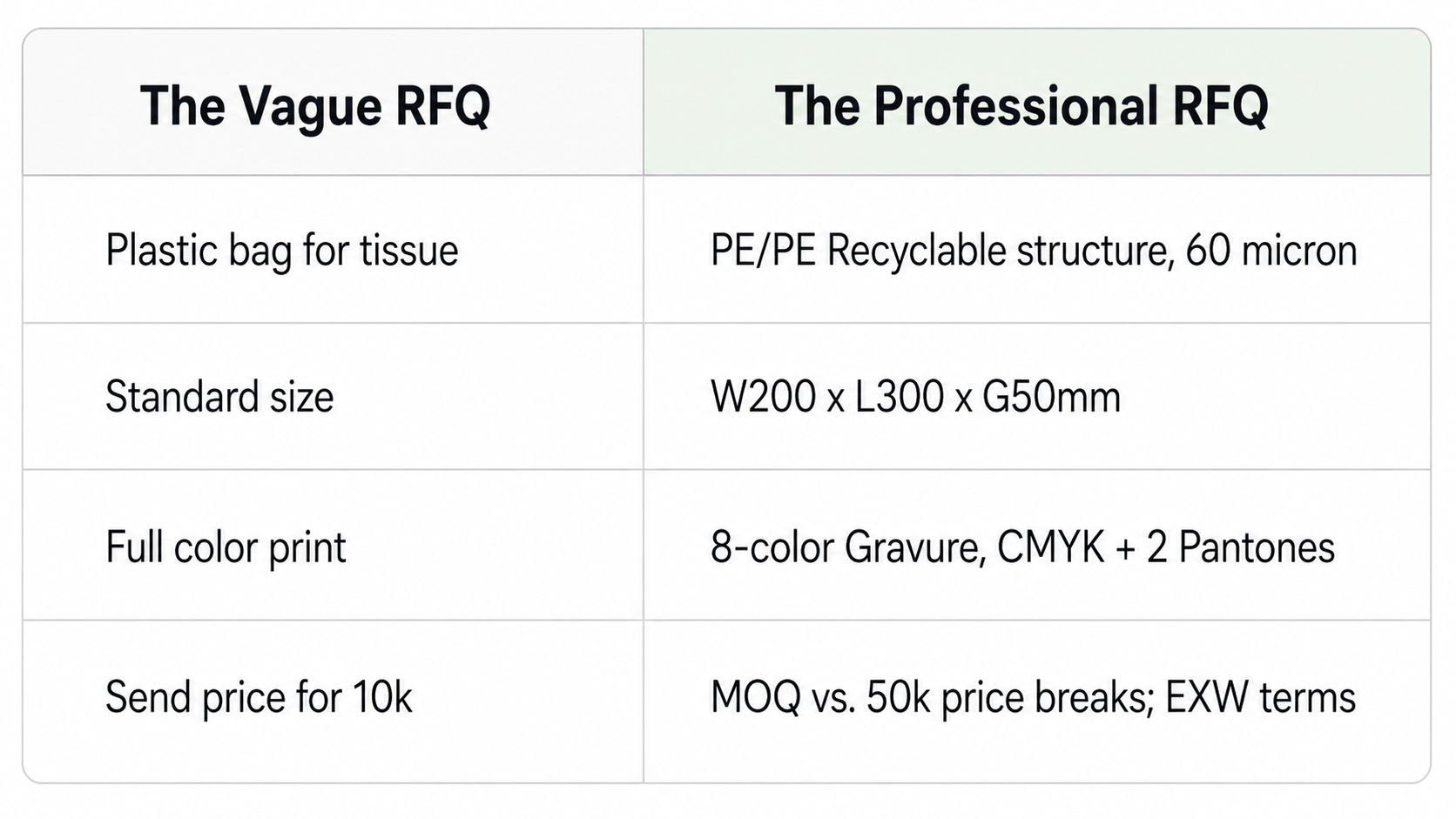
An RFQ (Request for Quote) is more than a price check; it is a technical blueprint. If your brief is vague, your quote will be "padded" with extra costs to cover the supplier's risk.
1. Defining the Product & Function
Before you ask for a price, you must define the application. Different products require different barrier properties.
Hygiene & Tissue: Needs high machinability for high-speed lines (e.g., Toilet Tissue Packaging).
Pet Care: Requires high puncture resistance and odor barriers.
E-commerce: Focuses on tensile strength and "tamper-evident" seals.
Jecpack Pro-Tip: Don't just say "plastic bag." Tell us the weight of the contents. A 5kg bag of pet food requires a completely different resin blend than a 500g pack of wipes.
2. Technical Specifications (The "Meat" of the RFQ)
To compare "apples to apples," you must provide these four technical pillars:
A. Material Structure & Sustainability
Are you looking for a single-layer film or a multi-layer laminate?
Standard: PET/PE or BOPP/PE.
Sustainable:Mono-material PE/PE structures are the 2026 industry standard for recyclability.
Barrier: Do you need VMPET for moisture/light protection?
B. Thickness (Microns)
Thickness affects cost and machine performance.
Optimization: Ask your supplier if you can "downgauge." Sometimes a 50-micron high-performance film is stronger than a 70-micron basic film.
C. Dimensions
For bags, provide Width x Length x Gusset. For Roll Stock, provide:
Outer Diameter (OD) limit
Core size (usually 3" or 6")
Unwind direction (Standard positions 1-4)
3. Custom Printing & Artwork Data
Artwork is production data, not just aesthetics. To avoid "hidden" tooling fees, specify:
Printing Method: Usually Gravure for high volume or Flexo for specific textures.
Cylinder Count: Each color requires a physical cylinder.
Finish: Matte, Glossy, or "Spot UV" (selective gloss).
4. Production & Machine Compatibility
This is the most overlooked section. Your packaging must survive your factory.
Packing Method: Is it manual filling or a high-speed VFFS (Vertical Form Fill Seal) machine?
Coefficient of Friction (COF): If a film is too "slippery" or too "sticky," it will jam your high-speed rollers.
5. Quality Control: Questions to Ask
Professional buyers don't just ask "how much"; they ask "how sure." Include these QC requirements in your RFQ:
Tensile & Seal Strength: How do you test if the bottom will burst?
Color Consistency: Do you use X-Rite Spectrophotometers to match my Pantone?
Traceability: Can you trace a defect back to a specific resin batch?
The 60-Second RFQ Template
Copy and paste this into your next email to a supplier:
Subject: RFQ: Custom [Product Type] Packaging - [Your Company Name]
Application: [e.g., Diaper Packaging / Industrial Film]
Format: [e.g., Premade Side-Gusset Bag / Roll Stock]
Dimensions: [W x L x G]
Material: [e.g., PE/PE Recyclable or Please Recommend]
Thickness: [e.g., 65 Microns]
Print: [e.g., 6 Colors, Matte Finish]
Quantity: [e.g., 20,000 and 50,000 units]
Logistics: [e.g., FOB Ningbo or DDP New York]
Special Req: [e.g., Must be compatible with [Machine Brand] wrapper]
Ready to optimize your packaging?
A professional supplier should challenge your brief to save you money. At Jecpack, we specialize in high-performance Flexible Packaging Solutions that balance cost with sustainability.